
By day eight of the archaeological reconnaissance dig in Ficulle, Italy, most of the excavation team’s initial theories had already turned to ash and dust. Trench A was not an animal pen but a burial site. Animal bones were actually human. There was no evidence that the site was an inn for merchants on their way from Arezzo to Rome. A student’s field notebook read, “I don’t know if I like this. There’s too much chaos.” With three days to go before the team was scheduled to journey back to Oklahoma, Drs. Joey Williams and Sue Alcock were hoping for some of what archaeologists call ‘last day magic.’ “It’s kind of urban legend, but it actually happens,” says Alcock. As the superstition goes, the greatest finds are notoriously found in the eleventh hour. The clock was ticking for this magic to materialize for the scientists and their dozen students.
Leaving my guest house north of town, I drove through sunflower fields, watching dust clouds fill up my rearview mirror. I was meeting the archaeologists to document the dig, unsure of what they would find, and subsequently, what I would find.
The team gathered on this late July morning across from the Agroflora shop in Ficulle before the half-hour drive to the dig site. The Umbrian sun was already hot and bathed the stone and tile buildings of the 11th century village with a warm, egg-yolk colored glow. As we piled into vans and began our day’s journey, the scenery changed from medieval to jungle-like. Thick clusters of trees dotted bumpy dirt roads that hugged the Chiani River. We parked at an opening into the woods and hiked another 15 minutes until we reached the open field where the crew had spent the last three weeks excavating.
Joey and Sue’s team were not the first ones here. The site had been excavated in 1883 in the interim between antiquarianism and modern-day methods of excavation and anthropology. The dig had been published in the Italian Annual Review of Excavations and documented finding an inscription with the name Tiberius Claudious Thermodon. Sue and Joey’s team determined that the site contained a grave, a spring, a bath house, and two grain mills. Beyond this, the identity of Thermodon—and the purpose of the site—remained largely a mystery.
Most of the group was now zeroing their focus on Trench E. Uphill from the other trenches, E showed a major anomaly in the magnetometry data. Senior Researcher Dr. Scott Hammerstead attempted ground penetrating radar on the area only for an extraordinary amount of clay in the soil to scatter the signal. Multiple crew members took turns digging in the trench with shovels, trowels, and pickaxes. The location and depth of E—along with a previously documented inscription from Thermodon to Mithras—served the hypothesis that the trench could be a Mithraeum—a shrine to the locally revered god.
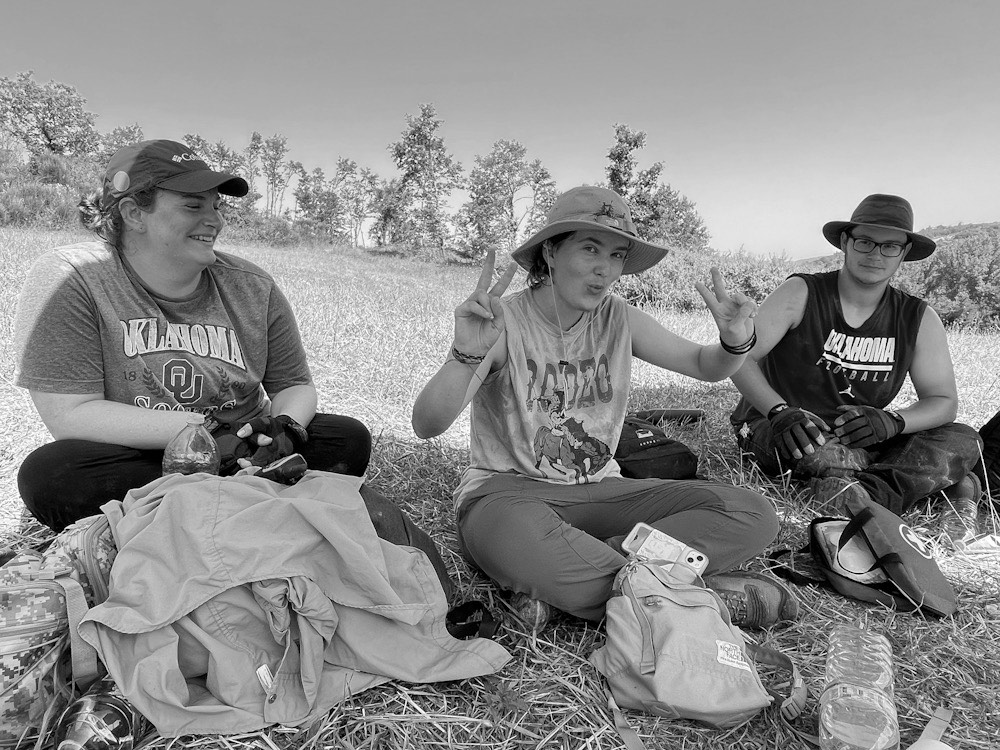
The physical labor and the hot sun left the team in soaked clothing within minutes. Sore knees were covered in dirt or clay, and beads of sweat were routinely wiped by dirt-caked hands. Students took turns digging, cleaning artifacts, or sorting any cultural materials into buckets. Breaks were taken under a large tent where the students would write in their field note journals, cool in the shade, and eat Italian Pringles chips, of which Paprika was the most popular flavor. Gus Stroud was resting and acting out a dramatic diatribe on Dante when I approached.
Gus asked his fellow students. A history major with a fixation on all things Renaissance and Ziggy Stardust, Gus was allotted one Dante reference a day by his peers.
“When halfway through the journey of our life, I found that I was in a gloomy wood,” Gus quoted.
“No, that’s not correct. You have to say it in the original Italian,” replied Claudio Bizzarri, an older man with a thick Italian accent. Claudio is a third-generation archaeologist and the dig’s project coordinator. Stoic and usually silent, when he interjected into conversation it was usually equipped with a profound knowledge of the Italian language and culture.
Gus waved his hands dramatically, “That’s why I’m learning Italian, so I can read Dante in the original language.”
“I hear you’re referred to as ‘Lord of Trench A’ by your friends out here,” I said.
A toothy smile broke across Gus’s face. “Yes!” he yelled. “I LOVE Trench A, it’s my favorite.”
Gus led the way to his beloved Trench A where pan tiles and a wall were visible. The human remains found in the trench indicated it was a burial site, Gus explained, as I stepped in with him.
“Another fun thing about this job is you just don’t know. There’s a lot of guessing and theorizing until you do know, and sometimes you never do,” he said.
The team began to pack it up for the day around one o’clock when the heat became difficult to tolerate. I drove back to my guest house making notes to read Dante.
The following morning, I drove back out to the site following make-shift directions from Sue and found multiple crew members huddled around Trench E. That morning, while cleaning the trench at roughly 150 centimeters deep, Hannah Cox, an OU Classics and Microbiology major, hit something with her tools.
“How big is that? Is that one piece?” Claudio asked.
Gus jumped in to assist Hannah and uncovered a large, rectangular stone. Possibly a bench or steppingstone for a Mithraeum. The crew was excited for the potential relevance of the find.
“Or possibly a really big rock,” Scott chimed in.
By the end of the week, the team still didn’t know. It was time to backfill, clean, and go home. Hopeful that the grant to dig would be renewed the following summer, the team would leave with more questions than they had answers. Claudio sat beneath the shade of the tent and considered the end of the dig. “You get up in the morning, you don’t know how it’s going to end in the evening,” he said with a shrug.
But that wasn’t really why anybody was here. Every one of us was a gambler of sorts, motivated by uncertainty and the unknown. Leaving with more curiosity than satisfaction was a part of the thrill. The stretching of the imagination, the hypothesizing, the guessing into oblivion of the unknowable was somehow more gratifying than the tiny pottery-like fragments that we could know for sure.
Driving through the same fields of sunflowers, I left with questions, too. Would we ever know the identity of Tiberius Claudious Thermadon? Was Trench E the burnt fragments of a passed away god? Would Gus learn enough Italian to read Dante in his native tongue?
Maybe I didn’t really want to know.