
“Go now, and preach the word. Go now, and preach the word. Go now, and preach the word. The Son took the book out the Father’s hand…”
My maternal grandfather was from a rural community in Alabama. He and my grandmother eventually moved to the San Francisco Bay Area around 1941, from Tulsa, Oklahoma, as part of the second wave of the “Great Migration.” They were preceded by thousands of people from Oklahoma, Missouri, Arkansas, and Texas who sought sustainable futures in the far west during the 1930s—people whose ties to the land persisted even as environmental conditions worsened. While most of the mass movements west during the first three decades of the 20th century were connected to land, loss, and freedom, this second act during WWII was fueled by the possibility of economic prosperity. I suppose they were all driven by hope.
As a result of their earlier decision to move to California, I was raised in a community of elders from the Great Plains, Deep South, Southwest, Mexico, Asia, and the Pacific Islands who had lives reflecting both the regional cultures “back home” and the progressive West of the late 1970s and early 1980s. They brought with them their histories, memories, and songs. Due to radical shifts in the 1960s, there was a reversal in thinking regarding assimilation by the time most of my friends and I were growing up. We did not know to be readily ashamed of accents, cultural “differences,” food, or language, even if as children we made fun of the old people in our lives. Being in the multicultural and multigenerational space meant being exposed to stories of places that seemed faraway and magical, even when they were not. Places, like rural Alabama.
By the time I met my grandfather, he was docile and pious, with a slight shuffle in his walk resulting from “that stroke” he had several years before my birth. He was in his 70s, and from what I learned from his children, he lived an eventful life. His is a very typical story of African Americans during the early 1900s in the Deep South. He grew up economically poor and was educated until about the age of eight or nine when he then had to go “work in the fields” to help take care of the family. His lack of education or wealth coupled with his gender and racial identity in segregated Alabama sealed his fate. The move to California was not his first attempt to break the cycle. His mother moved north with him and his siblings when he was a preteen, and he moved again and again, until he did not.
When I was young, anytime my grandfather was not watching baseball or People’s Court (“Judge Wapner”), he would tinker around the house or take a daily drive through town to pass the time. He was both a deacon and custodian for a tiny Pentecostal church two blocks away from the house, and he made sure the doors were locked and opened when necessary. At home he would lean on the porch railing watching the occasional car ride down the street and wave to those who might walk by. And sometimes he would sing. One song in particular was one he brought with him. He learned the song as a child in his rural community, and he eventually taught it to the congregation at his small church in northern California, all of whose older members are now deceased. I learned the song and grew up singing it, too. I still remember the words. Tracing that song alone, we learn about geography, religious practices, and political history. It is a cultural artifact. In the 1950s, Folkways Records released six recorded volumes titled “Negro Folk Music of Alabama,” and the Smithsonian Institution has since reissued the curated collection. The song my grandfather sang is not included, and I know his is not the only one.
As someone who has worked with African American archives for most of my career, I think about the importance of material culture a lot. During research, I find myself looking through boxes of uncategorized items donated to libraries. I clip digitized texts or images and store them on hard drives, hoping to contribute to their protection. When I travel abroad, I record (with permission) parts of conversations, songs, and dances, not as a tourist, but as someone who understands how much can be lost when a generation disappears. In 1925, the Afro-Latino scholar, collector, and archivist Arturo Schomburg wrote an essay about how it is the responsibility of the African American to “dig up his past” and take ownership of (his) own story. He saw the repeated contemporary arguments that Africans and African Americans had no history as not only false but detrimental to the progress of the “Race.” Schomburg states in plain terms, “the [African American] must remake his past in order to make his future.” In the essay, it is clear that “remake” also meant revisit, learn, and reclaim.
When I reflect on my education, cartographies of Black identity, place-consciousness, and Black geographies were always a part of my interests, but those were not the terms I was taught. Although I am a Westerner by birth and ancestry, I really started to think about what is now called “the Black West” through the study of place, space, geography, and mapping in literature. I came to research on pre-20th century Black Western history through my own interests in Black regional experiences reflected in historical fiction. For example, when reading and later teaching the play Flyin’ West by Pearl Cleage, I began exploring the “Exoduster movement” the historian Nell Irvin Painter wrote about two decades before. Through teaching Cleage’s drama, I became particularly interested in self-guided migrations of African Americans during “Reconstruction” and the communities formed in different places. I also began to think about how much material was left behind or carried forward, and where it is now.
I am currently the Director of Oklahoma Research for the Black Homesteader Project funded by the National Park Service in partnership with the Center for Great Plains Studies (Nebraska) and the University of Oklahoma. Studying the history of Black homesteaders in 19th and early 20th century rural Oklahoma Territory helps us understand racial politics, economic progress, the role and/or absence of tribal affiliation, land ownership, displacement, and social mobility. The relationships that were forged and communities built during this time are as important as the challenges faced. Within these histories are archaeological sites of knowledge and memory yet to be fully incorporated into the larger story. For example, between 1909-1912, before the better-known migration to California, approximately 1,500 Black people moved from Oklahoma to the Canada Plains. They were following calls from the Canadian government advertising land available to homestead on the Canadian prairie. Many included families who came to Oklahoma in the 1880s and 1890s from the southern United States. Others considered Oklahoma their ancestral “home” and had been there for a few generations. What both groups had in common was that they were seeking better opportunities than offered in a state that was becoming increasingly hostile to Black Americans.
Within these narratives, movement across state and national borders from one rural area into another is less understood and understudied because the story of progress is one that identifies urbanism as the accepted form of modernity. However, when considering early Black migration west, progress meant social and political freedom, and those dreams were often realized in rural spaces.
When I first accepted the role as project director, I was not thinking about creating an archive. Oklahoma is so intricately connected to the homesteading story, for better or worse, that I did not consider the possibility of not finding a road map to where we needed to go. I assumed the textual excavation would be easy. However, there is no known collection, database, or archive of documents capturing the history, experiences, and/or narratives of rural African American homesteaders and their descendants in western Oklahoma pre- and post-statehood. The lack of readily accessible data is a problem for institutions and state agencies attempting to accurately chronicle state history and address the needs and concerns of rural Oklahomans in the present
day. This also poses a problem for academic researchers and members of the public who have interests in topics relevant to rural African American populations, U.S. federal land policies, and general research in the region. The scattered and often missing evidence of Black life in these spaces makes it difficult for descendants, genealogists, and historians to trace and identify families or individuals. Although the vast majority of rural African American homesteads and communities cultivated during the era no longer have a physical presence, they should not remain buried under layers of disregard. The lack of visibility does not mean they do not matter.
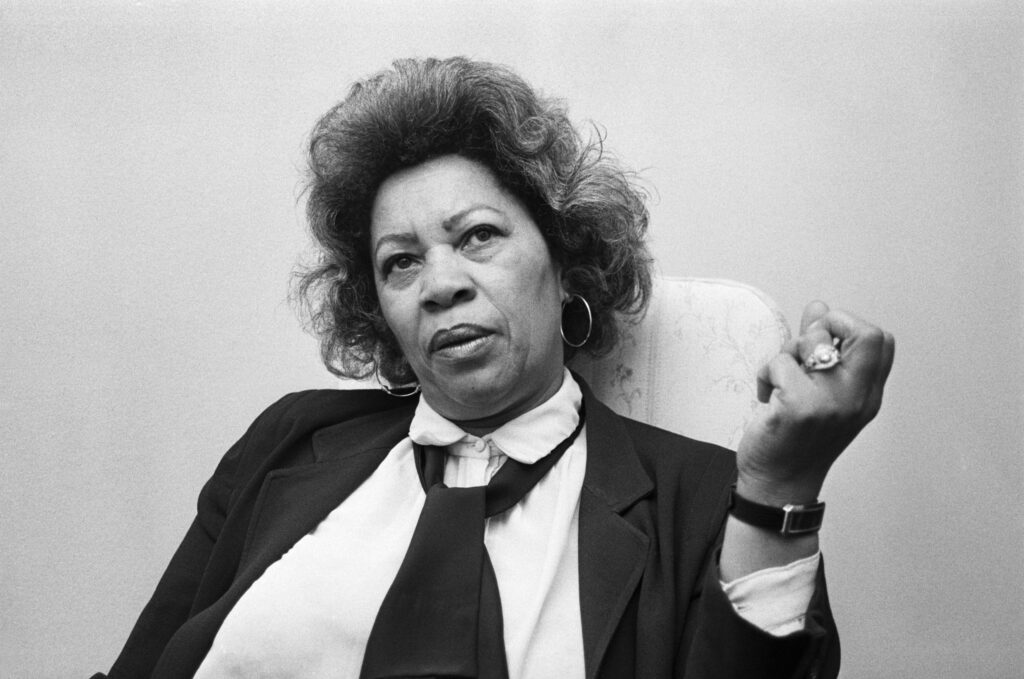
The famed author Toni Morrison is known for her fiction and essays that require the reader to confront American history in intimate ways. Her use of language is beautiful and stunning, as it is also damning. In the essay, “The Site of Memory,” when discussing how she crafts her writing and attempts to “gain access to the interior life” of rediscovered ancestors, she says: “It’s kind of literary archeology: On the basis of some information and a little bit of guesswork, you journey to a site to see what remains were left behind and to reconstruct the world that these remains imply. What makes it fiction is the nature of the imaginative act: my reliance on the image–on the remains–in addition to recollection, to yield up a kind of a truth.”
Those of us who work within African American/Africana Studies are finding ourselves engaging more in the archaeological study of Black lives. We are on a journey to find what we do not know.
However, technological advancements are making it easier to preserve and compare these artifacts. We can hold and record video calls with several people from across the country. We can use search engines to locate descendants. AI software is being developed that will have the ability to assess and analyze in ways not possible before. Whether there is a conscious collective effort or not, the outcome could be that for future generations, the “sites” they return to will yield more information. There will potentially be less guesswork, and the piecing together might be less fraught.
For over a century, Black historians have been researching and writing about Black migration and settlement in the American west. Through the Oklahoma Black Homesteader Project, we are digging in, uncovering, and collecting new data to help fill in important gaps with an eye toward the future. We also know that culling information from multiple sources helps tell a more detailed story. The most exciting part of this project for me so far has been envisioning the landscape of 19th century rural western Oklahoma through the perspectives of Black families. The records of civic activities, organizations, and oral histories bring new life to the study. In his work, anthropologist David Scott notes:
[An archive is] “…the dense network of allusions, events, concepts, images, stories, figures, personalities, that inhabit the sub-terrain of statements, animating them, giving them sense as well as force…And because the archive is not in any simple way already there waiting to be read, it has at once to be recovered and described in order to be put to critical use. And this is the work of the archaeologist.”
I now realize I am contributing to a community archive. The recov ery process is giving new meaning to forgotten documents that will remain relevant in the future. And, although universities have been slow to recognize this type of work, public-facing scholarship must be the outcome of retrieving, analyzing, and remembering. As we uncover and preserve, what we do means little if we are not committed to making it accessible to the wider public. We must preach the word.