
Queer Archaeology and Heritage with the Rainbow Community Heritage Project
One of my favorite queer*spaces in Oklahoma today is the Reading Rainbow Book
Club. Like its namesake suggests,it is a place where queer folx* in the Oklahoma City area can gather over books that feature us. Since I began the coming-out process in 2020, this book club has been a happy place for me, where my queerness and nerdiness combine through engaging discussions with others about queer literature in a welcoming, safe place. On a damp, gray October day in 2022, I walked through the bookstore doors with one of my partners and sat down on my usual folding chair, clutching my marked-up paperback copy of our book and making small talk with familiar faces before we started the discussion.
However, the meeting took an unusually somber turn for two reasons. First, a cisgendered*, heterosexual woman and her non-bi-nary* teenagers found our little book club as their first attempt to find a community for the youth – unusual as our book club is primarily adult-focused. I, along with other book club members, immediately felt protective of this queer youth, acutely aware how difficult it must be to come out as non-binary as a teenager in Oklahoma. Second, our meeting had a special guest speaker: a representative from the American Civil Liberties Union of Oklahoma (ACLU) was there to discuss the anti-transgender legislation the state legislature was proposing, including bills banning gender-affirming care for those under thage of 18. The reality of those bans hit me hard, especially given the age of our newest book club member sitting in our circle. As the representative gathered her things to leave, the teenager took a homemade rainbow bracelet with plastic beads off their wrist and offered it to her as a quiet “thank you” for her work fighting for their rights. With the weight of that intense conversation on our minds, we launched into discussing the queer book we had read.
While we talked, the quiet act of the bracelet exchange stuck with me and inspired me to give the teenager my copy of the book after the discussion, hoping it would make them feel welcome in the group. That memory continued to inspire me long after that day to reflect on what queer objects look like and how we as queer folx use them. I also began to wonder what queer objects have meant to us, both to folx like me today and our elders in the past.
Reading Rainbow Book Club OKC, featuring books read and discussed, at Full Circle Bookstore.
Queer*: Originally a 19th and 20th century slur against members of the LGBTQ+
community, this reclaimed word now broadly represents sexual orientation and/or gender identities outside of the cisgendered, heteronormative standards of Western culture Folx*: The inclusive term for “folks,” used to acknowledge the diversity of gender expressions in the
queer community Cisgendered*: An individual who identifies with the gender assigned to them at birth Non-binary*: A gender identity in which the individual does not identify within the gender binary of male and female
Bisexual*: A sexual orientation in which an individual is attracted to two or more genders Polyamorous*: A relationship orientation on the ethical non monogamy spectrum, in which an individual is capable of having multiple romantic relationships simultaneously
Moments like these, and others, have forced me as a traditionally trained archaeologist and a white, cisgendered, bisexual*, polyamorous* woman to pause and reflect on the complicated nature of queerness and material culture. The small material exchanges were only possible in a place and time where queerness can be readily expressed in public spaces – something that has not always been the case. Queer theorist José Esteban Muñoz noted that, “[q]ueerness is often transmitted covertly. This has everything to do with the fact that leaving too much of a trace has often meant that the queer subject has left herself open for attack.” And he is right. Especially in red states like Oklahoma, it is not always physically or emotionally safe to seen as queer in public spaces. But we have always found ways to express, communicate, and bond in that queerness with others, through our material culture, even if the ways have changed over time. Like any culture, our elders expressed themselves differently than queer folx my age, especially those who were around prior to the creation of the Pride Flag in 1978. Additionally, unlike some cultures in which individuals are born into families well established in their heritage, queer folx are not automatically born into queer culture; we must find it on our own. All of this leads me to ask: how do queer folx use stuff to express themselves, today and in the past? What do our objects– our artifacts – and our sense of queer heritage mean to us and
our identity?
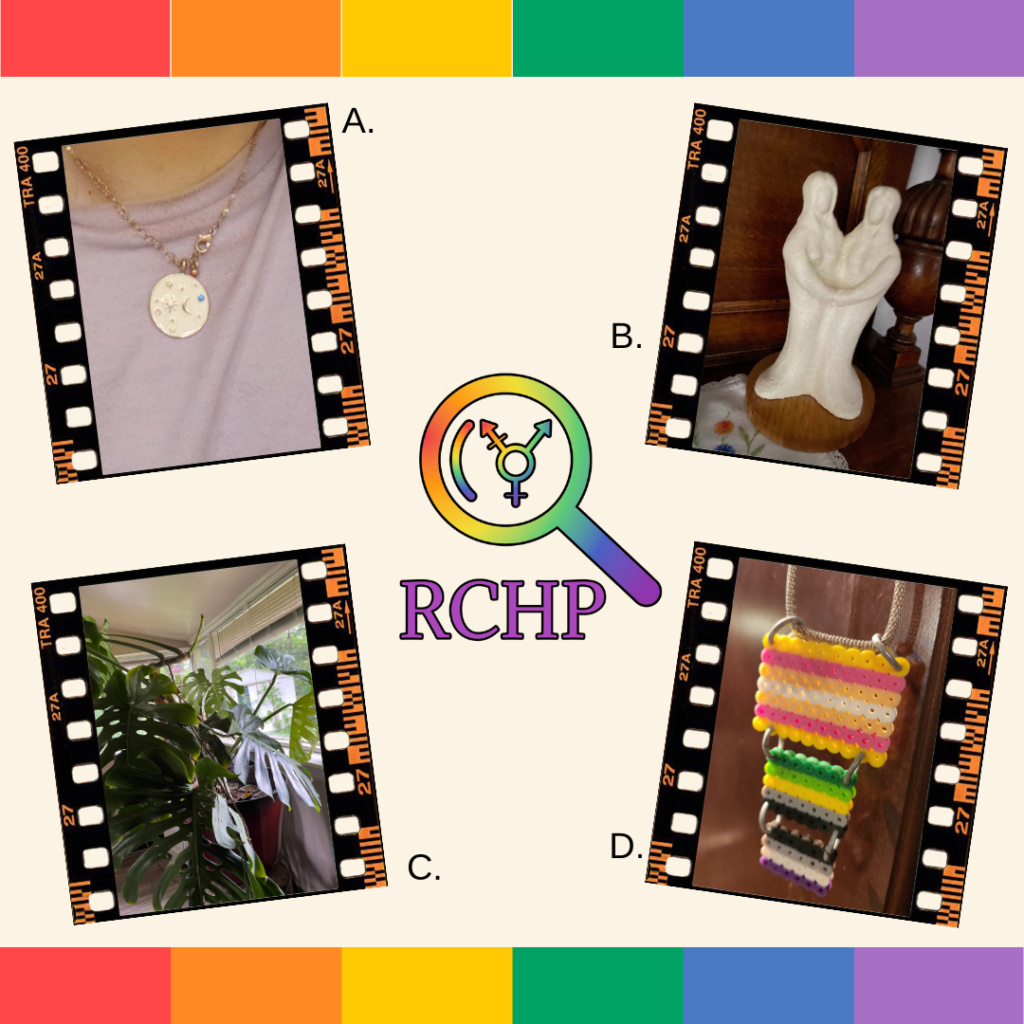
Four examples of queer artifacts from Oklahoma, currently displayed on the RCHP exhibit.
A. A sun-and-moon necklace, representing the
owner’s gender fluidity.
B. A sapphic statute of two women holding
and embracing one another.
C. A Monstera plant, representing self-care
and chosen family.
D. A homemade, beaded necklace of queer flags
representing the owner’s identities at the time of creation
for their first Pride event (the flags from top to bottom
are: pangender, aromantic, and asexual).
To answer these questions, I created the Rainbow Community Heritage Project (RCHP) with the help and support of many in my community as an Oklahoma Public Archaeology Network (OKPAN) initiative and a part of my dissertation research at the University of Oklahoma. RCH is a digital community archive and exhibit to preserve and share our artifacts (i.e., the objects in our lives) and stories with each other, while simultaneously helping me understand queer material culture and heritage without access to a local museum and collections to study – because such things currently do not exist. RCHP launched in spring 2023 and has already received 18 incredible submissions from nine states around the country, with seven of those from Oklahoma. So far, these submissions have taught me that anything can be a queer artifact: what makes it “queer” are the stories and meanings given to the object by the owner. As a community, queer folx routinely think outside the box, because our identities are outside of society’s box, and our artifacts mirror that fact. They range from jewelry, such as a necklace, enamel pin, and engagement ring; to artwork, like a framed quote and a statue; to documents, like Anita Bryant pamphlets to name-change paperwork; to tools like a carabiner and microscope; to even a plant. I have also learned that connecting to queer heritage validates our identities and extends a sense of community into the past and the future. As one Oklahoma participant who shared their own painting of the genderfluid* flag explains“Heritage to me means having an understanding of where you come from and who has come before
you. It means having a history you can see yourself in to know that you are not and never were alone. Heritage means belonging. I think my artifact symbolizes this because gender non-conforming people have been pushed so far to the fray of history that we often forget we’ve always been here. Artifacts like mine throughout history are tangible proof we always have been and always will be.” Queer heritage is dynamic and not simply a relic of the past. Queer heritage is about community: a connecting to our elders and learning from their stories; an active project today for future generations; and a validation of our identity in a society that does not always accept us. At the end of the day, I keep coming back to that gifted bracelet at the Reading Rainbow Book Club. From what I have been learning, it is a symbol of what artifacts and queer heritage mean to us. An RCHP participant from New York said it best: “Heritage can be grounding. It’s so important to know who came before you and gave you the rights you have now. Our queer ancestors fought, died, were abused, neglected, ostracized all so that we can live a freer life. They loved us before knowing
us. I think that’s the legacy of being queer. Love. Radical love for our queer family members everywhere. Whether we know them, have even met them, or not.” We are a culture of radical love for ourselves and our community; we always have been and always will be. And our artifacts prove that.
Genderfluid*: A person whose gender identity is not fixed
This artifact comes from a RCHP participant in Oklahoma. This painting, made by the participant themselves, represents the genderfluid flag, and is important to them “because it was the first time I felt like I put my gender into the world in a concrete and tangible way. The painting was made shortly after I realized I was genderfluid using the colors of the flag with supplies my (not the most supportive) relatives had recently gotten me.”
Meghan J. Dudley (she/her) is a PhD candidate in the Department of Anthropology at the University of Oklahoma and OKPAN’s Archaeology Education Coordinator.