
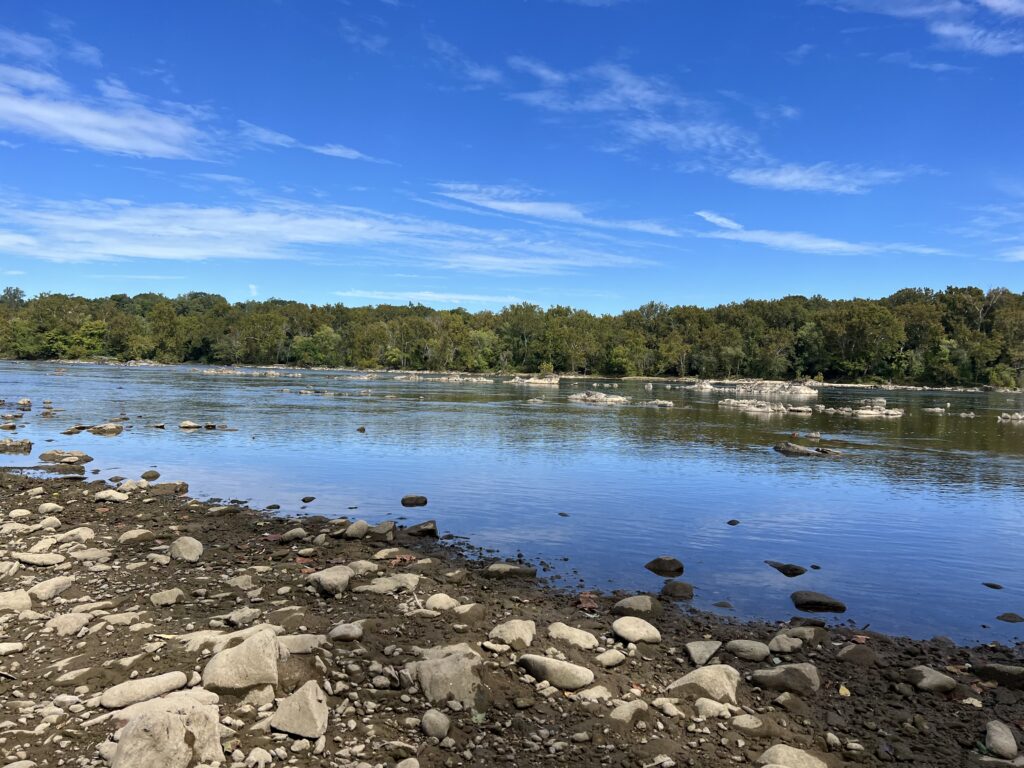
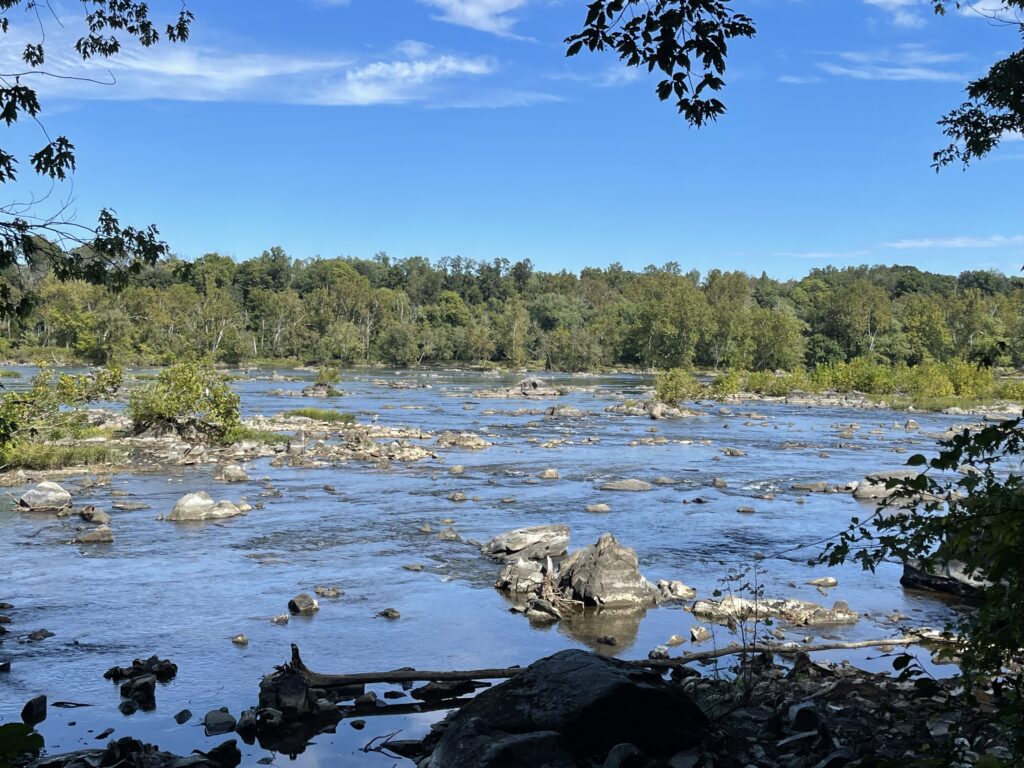
When sunlight finally rose above the frozen canopy and raced along the river’s glassy surface, we had already been up for hours. It was February, and our survey team had been contracted to look for archaeological sites along the Potomac River, Virginia, from Turkey Run down to Old Town Alexandria. Through ice-storms and bone-chilling winds, we successfully identified a multitude of sites spanning centuries. Three weeks of surveying had revealed the layouts of an Italian American community, a Freedmen village, and multiple Indigenous rock art sites. For someone who grew up in the area, experiencing cultural history I had not previously been exposed to was exhilarating.
But despite my excitement, I remember my heart plummeting after learning what came next. Our crew was excavating near Fort Marcy one morning when another field tech let out a startled cry. Everyone instantly dropped their gear and sprinted over to the source of the commotion. When I arrived, I found several crew members bent over, peering into a freshly dug pit. Stretching my neck over shoulders to see for myself, I glimpsed what had captivated the crew’s attention. Resting at the bottom was a quartz lanceolate point, the winter sun reflecting off its crystal surface.
Stepping back, I asked our crew chief, “What happens now?”
Her face twisted. “What do you mean? Bag, tag, and make a note in the report—just like everything else”.
My stomach dropped. That’s it? An object representing several millennia of human history, a stone’s throw away from the nation’s capital, and the only significance warranted was a footnote?! Reality struck like a sucker punch to the jaw; most of the knowledge we uncovered would go into an unpublished report, slated to lie in an obscure repository for subsequent review. The awareness was unsettling. If I was going to be an archaeologist, I wanted to share this knowledge. I began my applications to graduate school later that year.
Archaeologists are storytellers. To many, we are cited as stewards, individuals responsible for sharing the knowledge of how people lived in the past. But as Indigenous, Black, and Feminist scholarship has pointed out, harm occurs when this knowledge is withheld or misused. From my experience as a field technician, I observed archaeology play into the continued removal of knowledge of several historically marginalized spaces.
I started my master’s program at the University of Alabama in 2017. When I arrived, an opportunity presented itself for me to examine ceramic artifacts from an eighteenth-century Choctaw village site called Shumo Takali or “Hanging Moss”. Remembering my experience from surveying along the Potomac, I decided to contact the Choctaw Nation’s Historic Preservation Department (CNHP). If I was going to tell a story of Choctaw history, Choctaw voices needed to be present throughout the project. For the next two years, I worked closely with the office to involve community members in research design and data collection. Towards the project’s end, I presented results at a large community event and used the following conversations to form the discussion section of the report.
My definition of “community archaeology” comes from scholars working in Indigenous spaces—archaeology done for, with, and by communities. Interweaving sentiment, granting authority, and ensuring community ownership of the project are all elements that should be prioritized in collaborative studies. In working with Indigenous groups, privileging non-Western theories as a means of knowing should be an additional priority. At their core, these projects aim to decentralize knowledge production–ensuring that the broader impacts of the research are beneficial–not exploitative.
Developing a dissertation project centered on these principles was a goal for me when I arrived in Oklahoma. In the first year of my program, I met with several members of CNHP and explicitly asked what topics would benefit the Tribe. After months of planning and discussion, we decided to outline a community-based project focused on historic Choctaw homesteads in Oklahoma.
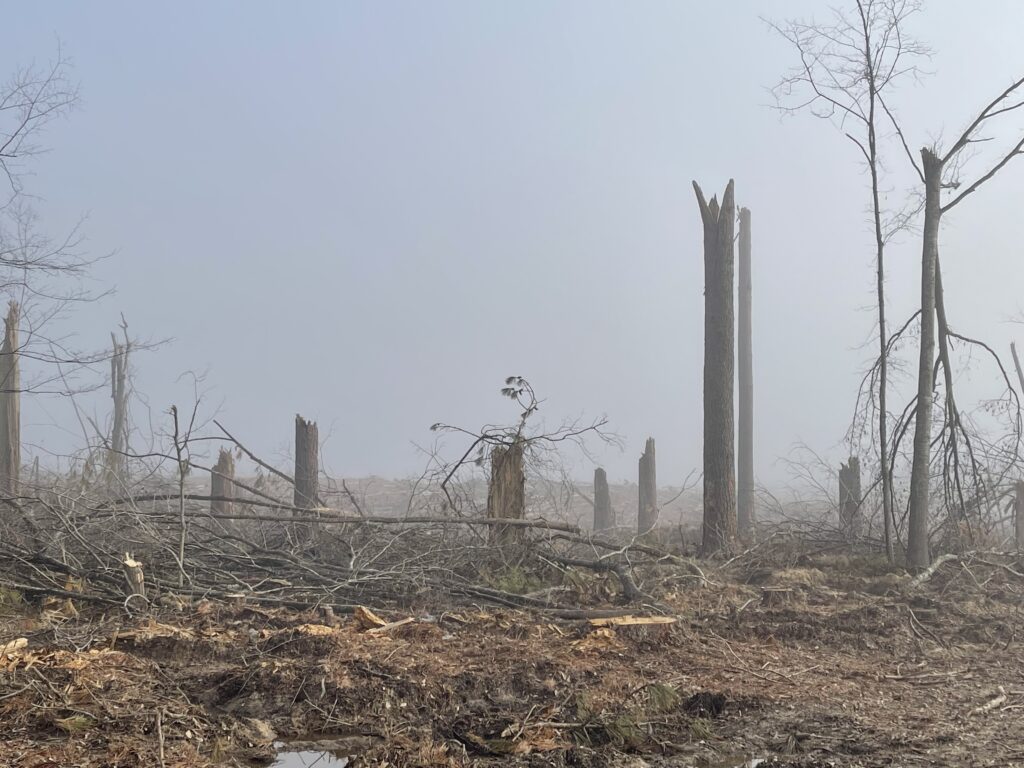
Following the passage of the Indian Removal Act in 1830, the US War Department forcibly removed thousands of Choctaw from their homeland in Mississippi. Upon arriving in Indian Territory, many families constructed homes in the form of log cabins. Identifying and protecting these sites is a major concern among Tribal members as clear-cutting and other industrial activities continually threaten these sites with destruction. However, a lack of scholarship on Native American archaeological sites in Oklahoma has made this difficult. Additionally, the knowledge gap rooted in decades of academic disinterest in Historic Indigenous spaces complicates Tribal efforts to learn about the broader impacts Removal had upon Choctaw lifeways.
For several years, I have worked with CNHP to form a project that could address these problems. In addition to our successes, community archaeology can also come with its own set of unique challenges. While none of these are insurmountable, navigating them requires a substantial degree of self-awareness.
Communication is paramount for collaborative research. However, the isolation and travel restrictions in effect from 2020-2022 severely hampered how many students communicated.
Volunteering soon became an essential way for me to maintain communication with CNHP. As part of the Section 106 review process, the department routinely submits research requests through the Office of the Oklahoma State Archaeologist, a costly and time-consuming task. Shortly after the COVID-19 outbreak, I offered to process these requests on behalf of CNHP. While this not only assists the department in fulfilling its preservation goals, it has also kept an open line of communication between myself and the community.
Transparency is another element of collaboration necessary for ethical research. Investigators should be willing to embrace accountability by providing updates and conveying all aspects of the research process. While this helps ensure the project will achieve its intended goals, it can also highlight points that might need attention–something beneficial for all parties involved.
Talking behind a computer screen can sometimes make a person feel hidden and removed. On several occasions, aiming to be transparent in a virtual environment has sometimes made me feel inauthentic. Once travel restrictions were lifted, I began scheduling in-person meetings with CNHP once a quarter. Following arrival and dispensing of coffee and pastries, we gather in a break room to start a series of river-like interactions, presentation flowing into questions into discussion into storytelling. This is where I consider most of what I call collaboration occurs. In laying out the project entirely and providing updates, CNHP staff and I address concerns, ask questions, solicit advice, select interests, discuss terminology, propose methods, consider results, construct interpretations, and coordinate dissemination. Nothing is trivial about these meetings; these events are how community experience drives the project.
Disillusioned with the approach to archaeology in my home along the Potomac, I sought to reinvent myself as someone who ensured knowledge stayed within communities. However, in navigating the unique challenges of community archaeology in graduate school, I learned an additional lesson: community archaeology is about building relationships. Communication and transparency are important, but none of these amount to anything without trust.
Many years ago, before setting out to become an archaeologist, I had an opportunity to witness the importance of these relationships when a professor of mine was invited to present at a local historical society meeting. For years, this scholar had worked with local communities to share the cultural history of the surrounding landscape. Unfortunately, the night they were scheduled to present coincided with a severe thunderstorm. When we finally arrived at the venue, we froze in astonishment. I had expected maybe a dozen attendees, but as it turned out, no fewer than a hundred people eagerly awaited us inside. It looked as if someone had invited the entire town!
Attendees continued to mingle after the talk. They asked questions and shared stories. Some offered to donate their personal artifact collections to our university’s museum. But this wasn’t just the product of shared interest. Rather, this professor had spent years cultivating a personal relationship with the people who called this landscape home. As we drove off, I looked back to see attendees still engaging with one another, as if oblivious to the lightning that periodically streaked across a hazy emerald sky. The energy had been electric, and I decided then I wanted to be a part of it.